
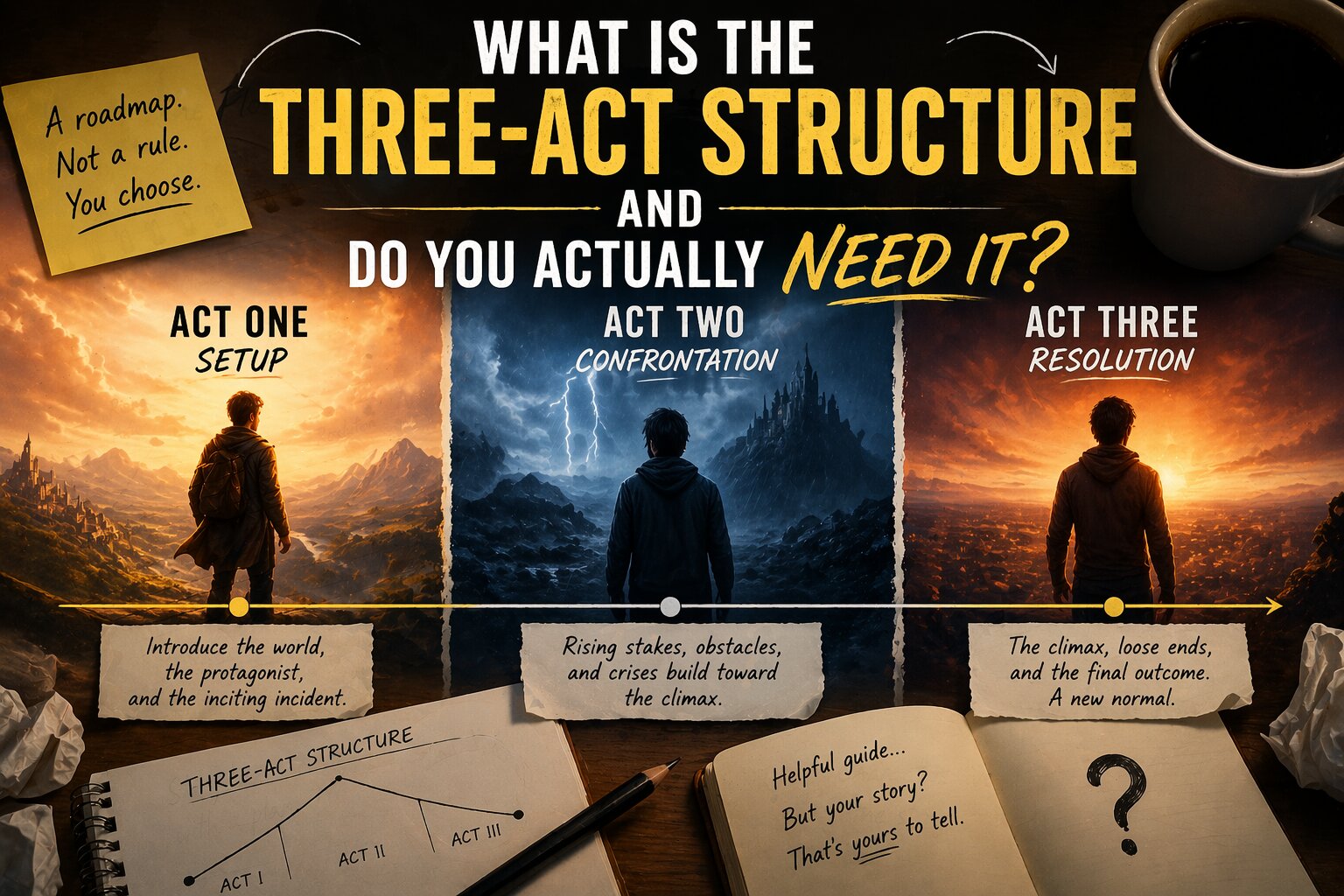
The honest answer most writing guides won’t give you: the three-act structure is simultaneously the most useful tool in storytelling and the most misunderstood one. You probably need it — just not in the way you think.
Every writer eventually encounters the three-act structure. For some, it arrives as a liberating map — a clear framework that explains why certain stories work, and others fall apart. For others, it arrives as a cage: a formulaic template that threatens to reduce the messy, human art of fiction into a mechanical checklist.
Both reactions are understandable. And both miss the point.
This article explains what the three-act structure actually is, where it came from, how each of its moving parts functions, what it costs you if you ignore it, and — crucially — what your real alternatives are. By the end, you’ll have a genuinely useful answer to the question “do I need this?” rather than the vague “it depends” that most guides offer and immediately abandon.
Where the Three-Act Structure Comes From
Before getting into mechanics, it helps to know the structure’s origin — because that origin explains both its power and its limitations.
The notion of three-act storytelling traces back to Aristotle, who theorized on story beats in Poetics. He argued that stories are a chain of cause-and-effect actions, with each action inspiring subsequent actions until a story reaches its end. Aristotle wasn’t prescribing a template for future writers. He was describing a pattern he observed in the Greek tragedies of his era — explaining what was already working.
That distinction matters enormously. The three-act structure is a description of how effective stories tend to behave, not a prescription for how all stories must be built. This is the single most important thing to understand about it, and it’s the source of most of the confusion that surrounds it.
In its modern form, the structure was popularized by screenwriter Syd Field in his 1979 book Screenplay: The Foundations of Screenwriting. Field codified the pattern for Hollywood filmmaking, giving it the specific terminology — setup, confrontation, resolution — that writers still use today. Since then, novelists, playwrights, and storytellers across every medium have adapted, debated, and built upon it.
What makes this framework endure across two and a half millennia isn’t cultural habit or creative laziness. It’s that the pattern it describes reflects something true about how human beings process narrative experience. Readers and audiences have internalized this shape. When a story delivers it — even imperfectly — it satisfies in a way that feels almost physiological. When a story violates it without deliberate intent, readers sense something is wrong, even if they can’t name it.
What the Three-Act Structure Actually Is
At its most fundamental level, the structure is deceptively simple: a story has a beginning, a middle, and an end. But those three broad containers each carry specific weight, and within them, a series of smaller structural moments — called beats — do the real work.
Here is what you’ll find in the three-act structure:
Act 1: Setup — Exposition, Inciting Incident, First Plot Point
Act 2: Confrontation — Rising Action, Midpoint, Second Plot Point
Act 3: Resolution — Pre-Climax, Climax, Denouement
Let’s break each down with real clarity, because most explanations stop at the labels without explaining the function.
Act 1: The Setup (roughly the first 20–25% of the story)
The first act establishes what “normal” looks like for your protagonist. Think of it as the “before” picture. Without it, the transformation that comes later has no baseline, no contrast, no emotional weight. The reader needs to see who your character is before the story begins, demanding things of them.
Within Act 1, the most important moment is the inciting incident — the event that disrupts the normal world and poses the story’s central dramatic question. This is not just “something happens.” It’s the specific event that makes the old status quo impossible to maintain. Dorothy’s house gets swept up by a tornado. Luke Skywalker finds the holographic message from Princess Leia. The inciting incident is the story’s invitation: here is a world changed, here is a protagonist who must respond.
The act closes with the first plot point — the moment of no return, where the protagonist commits (or is forced into) the new situation that will dominate Act 2. This is the door that locks behind them. A story is not a series of things that happen to a character; it’s a series of decisions a character makes in response to external events. The first plot point is where that agency begins.
Act 2: The Confrontation (roughly the middle 50–60% of the story)
Act 2 is the longest act and, famously, the hardest to write. Many writers call it “the muddle in the middle” for good reason — it’s where most manuscripts lose momentum, drift, and quietly die.
The second act depicts the protagonist’s attempt to resolve the problem initiated by the first plot point, only to find themselves in ever-worsening situations. Part of the reason protagonists seem unable to resolve their problems in Act 2 is that they don’t yet have the skills, knowledge, or emotional growth needed to deal with what’s opposing them.
The midpoint — which falls roughly at the story’s structural center — is the most underappreciated beat in the entire structure. It is not a rest point. It is a reversal. Something shifts at the midpoint that changes the nature of the protagonist’s struggle. It might be a revelation, a failure, a sudden escalation of stakes, or a moment where the character’s false belief is directly challenged for the first time. Without a strong midpoint, Act 2 becomes a flat plateau of obstacles rather than an escalating climb.
The act closes with the second plot point — often called “the dark night of the soul” or the “all is lost” moment. This is the protagonist’s lowest point. Every resource they thought they had is gone, misused, or revealed to be inadequate. It is the darkest moment immediately before the story’s final act — and it must be earned. A false “all is lost” that the reader doesn’t believe destroys the emotional impact of the climax that follows.
Act 3: The Resolution (roughly the final 20–25%)
The third act begins with the protagonist picking themselves up from the dark night of the soul and choosing — consciously and actively — how to face the final confrontation. This is not something that happens to them. It is a decision. The most powerful climaxes are ones where the protagonist applies something they have learned or changed internally, not just a last burst of effort or luck.
The climax is the reason the story exists. It is where the central dramatic question gets answered. The denouement is the brief aftermath — the “after” picture that shows the reader how the world and the character have changed. Some stories keep the denouement very short. Others take time with it. Either is valid, but the denouement must exist in some form. Endings that cut off immediately after the climax feel amputated.
Why Act 2 Keeps Killing Your Novel
Most writing guides explain the three-act structure and then move on. What they fail to address is why the same writers who understand the structure still produce sagging, shapeless second acts that lose readers before the climax ever arrives.
The problem is usually one of three things:
Escalation without direction
Act 2 needs to be more than a series of obstacles. Each problem the protagonist encounters must be more difficult, more psychologically precise, and more directly connected to their core wound than the one before. If the stakes in chapter ten feel the same as they did in chapter three, the story isn’t moving — it’s cycling. The most common mistake writers make is not escalating conflict enough. The protagonist needs to be in a demonstrably worse position at every major turning point.
Lack of a strong midpoint
Many writers treat the midpoint as a placeholder — a structural obligation rather than a dramatic necessity. A well-executed midpoint changes the nature of the story itself. After the midpoint, the protagonist should be pursuing something different, or pursuing the same thing with a fundamentally different understanding of what it costs.
Subplots that don’t connect to the main arc
One useful technique for keeping Act 2 moving forward is bringing new supporting characters into play or building up subplots. But subplots that don’t ultimately connect back to the protagonist’s core struggle are structural ballast, not story. Every subplot should complicate or illuminate the main conflict — otherwise it belongs in a different book.
Do You Actually Need the Three-Act Structure?
Here is the honest answer: almost certainly yes — but not as a checklist, and not necessarily as a conscious tool during drafting.
When a story is doing what it’s supposed to do, it tends to fall into this shape whether the writer is thinking about it or not. Many writers who have never heard of the three-act structure still end up building their stories in a way that follows the same basic pattern without even trying.
This happens because the structure doesn’t impose itself on stories from outside. It emerges from inside them — from the basic logic of human experience. Every meaningful human situation has a before (status quo), a disruption (inciting incident), an extended struggle to restore or build a new equilibrium (the confrontation), and a resolution. Stories that follow this shape feel satisfying because they mirror the shape of experience itself.
What this means practically is that if you’re a writer who works intuitively — if you prefer to discover the story rather than pre-plan it — you don’t need to outline using three-act terminology. But you do need the underlying logic. You need a protagonist whose world changes, whose attempt to respond escalates into something more difficult, and whose final confrontation requires genuine growth or defeat.
If you can answer these questions, you already have the shape of your story:
- What is your character’s world before the story starts?
- What disrupts that world in a way that can’t be ignored?
- What does your character try and fail at before finding what they actually need?
- What forces the final confrontation, and what does it cost?
That is the three-act structure. Stripped of its terminology, it is simply the shape of a complete human story.
However — and this is important — there are situations where the three-act structure genuinely shouldn’t be your primary tool.
When You Might Use a Different Framework
The three-act structure is not the only valid story architecture. It is the most widely used, the most thoroughly studied, and the most historically proven. But it is also rooted in Western dramatic tradition, and it has competitors worth understanding.
The Hero’s Journey — developed by mythologist Joseph Campbell and his observation of myths across world cultures — is essentially the three-act structure mapped onto a deeper psychological arc of departure, transformation, and return. It works brilliantly for epic quests, fantasy, adventure, and any story that leans heavily on archetypal character transformation. It’s not a different structure so much as the three-act structure with more specific guidance on the character’s internal journey. The Hero’s Journey is Act One — Departure: the hero receives a call to adventure and leaves home. Act Two — Initiation: the hero faces challenges and ultimately conquers the ordeal. Act Three — Return: the hero comes home transformed.
Save the Cat — Blake Snyder’s screenplay framework, adapted for novels by Jessica Brody — provides 15 specific beat checkpoints across the story, with guidance not just on what happens but roughly when. It’s more granular than the three-act structure and particularly useful for plot-driven genre fiction where pacing precision matters. Its weakness is that slavish adherence to its beat timings can produce stories that feel mathematically assembled rather than organically developed.
The Story Circle — Dan Harmon’s eight-stage framework, adapted from Campbell, strips the complexity of the Hero’s Journey down to its purest form: a character leaves their zone of comfort, pursues a need, pays a price to get it, and returns changed. Its simplicity makes it especially useful for character-driven stories and television writing. It’s often the easiest entry point for writers who find the three-act structure too architectural and the Hero’s Journey too mythologically elaborate.
Freytag’s Pyramid — the classical five-stage model of exposition, rising action, climax, falling action, and resolution — is better suited to tragedies and stories where the protagonist’s decline is the narrative’s emotional center. In modern fiction, it appears most naturally in literary fiction with tragic arcs and in some forms of epic drama.
The critical insight about all of these: they are not competing systems. They are different lenses on the same underlying truth. The Hero’s Journey can nest comfortably inside a three-act shape. Save the Cat’s beats often align with the major structural turns of the three-act framework. The Story Circle is essentially the three-act structure in circular form, with the character’s transformation at its center. They all look different on the surface, but they track the same thing: where the story starts, what disrupts it, how the pressure builds, and what finally forces a resolution.
The “Cook vs. Chef” Distinction Every Writer Needs
One of the most clarifying ways to think about the three-act structure — and about all structural frameworks — is the distinction between a cook and a chef.
Cooks follow the recipe exactly. Their results are reliable but often predictable, lacking the creative signature that makes a story feel distinctly alive. Chefs also know the recipe — but they know it well enough to deviate from it intelligently. They add their own flair at specific moments because they understand exactly what role each element plays and what happens if they depart from it.
This is the goal: to understand the three-act structure deeply enough that you can choose when to follow it and when to break it — and know exactly what you’re trading when you do.
You have to know the rules to break them. For newer writers, mapping a story into the structure’s beats can help them see where each story element fits and identify what needs to be added or elevated. But the structure is a tool, not a target. An outline is only an outline. Once you begin drafting, the story should be primary. If the story demands a scene you didn’t outline, or a change from the structural plan, that’s what you need to do.
The three-act structure is a diagnostic tool as much as a planning tool. Even if you don’t outline using it, fitting a troublesome draft over its framework is one of the most reliable ways to identify exactly where a story is losing momentum, pacing, or coherence. Are there any beats missing? Are some too close together? This is where pacing issues that make stories lag or feel rushed become visible.
What Happens When You Ignore It Entirely
Some writers resist any structural framework as an imposition on creative freedom. This resistance is understandable — the fear of producing something formulaic is legitimate. But there is a significant difference between ignoring the three-act structure and transcending it.
Writers who transcend the structure do so deliberately, with a deep understanding of what they’re subverting and why. Their violations of conventional structure create meaning — disorientation becomes a theme, an absence of resolution becomes a statement, a missing climax becomes the story’s emotional center. Experimental and literary fiction often operates this way, and its departures from conventional structure are part of its artistic argument.
Writers who ignore the structure without that understanding tend to produce something different: manuscripts that wander without building, that have ideas but no escalation, that produce interesting scenes without narrative momentum. Readers close these books not because they wanted a formula but because they wanted movement — and they didn’t feel the story going anywhere.
If you don’t have at least some kind of plan, you are increasing your odds of writer’s block, of writing yourself into a corner, or abandoning structure altogether and just creating a meandering plot.
Structure doesn’t constrain the story. It gives the story the shape it needs to arrive somewhere.
The Real Answer to “Do You Need It?”
You need the underlying logic of the three-act structure: a world disrupted, a protagonist who struggles and escalates, a climax that requires genuine transformation, and a resolution that earns its closure.
You do not necessarily need to consciously apply the labels, time your beats to precise page percentages, or outline using a three-act template before you begin drafting.
Good stories don’t start with templates for act breaks; they start with memorable characters, vivid worldbuilding, and a protagonist whose journey is worth following. Once you have those in place, a three-act structure will likely naturally reveal itself.
What you need is enough structural awareness to recognize when your story is drifting — when Act 2 is cycling instead of escalating, when your midpoint isn’t turning anything, when your climax isn’t requiring your protagonist to change. That awareness comes from understanding the structure, even if you’re not using it as a prescription.
Readers don’t close a book and say, “Wow, that second turning point at exactly 50% was so mathematically precise!” They say, “I had to keep turning pages. I just had to see what happened next.” Structure is the invisible architecture that produces that feeling. Your job is to make it feel inevitable — not mechanical.
Quick-Reference Summary
What is the three-act structure?
A narrative framework dividing a story into Setup (Act 1), Confrontation (Act 2), and Resolution (Act 3). Originally described by Aristotle in Poetics and formalized for modern use by screenwriter Syd Field in 1979. It describes the natural shape of complete human stories: disruption, escalating struggle, and earned resolution.
The nine key beats:
Exposition → Inciting Incident → First Plot Point → Rising Action → Midpoint → Second Plot Point/All Is Lost → Pre-Climax → Climax → Denouement
Do you need it?
Yes — in the sense that your story needs the logic it encodes: a disrupted world, escalating stakes, genuine transformation, and earned resolution. No, in the sense that you don’t need to consciously outline using its terminology before you draft.
Key alternatives:
Hero’s Journey (deeper psychological arc, best for epics and fantasy), Save the Cat (beat-specific guidance, best for plot-driven genre fiction), Story Circle (eight-stage simplification, best for character-driven or TV writing), Freytag’s Pyramid (five-stage classical model, best for tragedies).
The most important insight:
All story structure frameworks are different descriptions of the same underlying truth — stories are about change. The three-act structure is the most universal and flexible container for that change. Understand it deeply enough to use it as a chef, not a cook. The goal is a story that feels inevitable, not one that feels assembled.
The three-act structure isn’t a cage. It’s a skeleton. Stories without skeletons don’t stand up. What you build around the skeleton — that’s your novel.
 Autobiography