
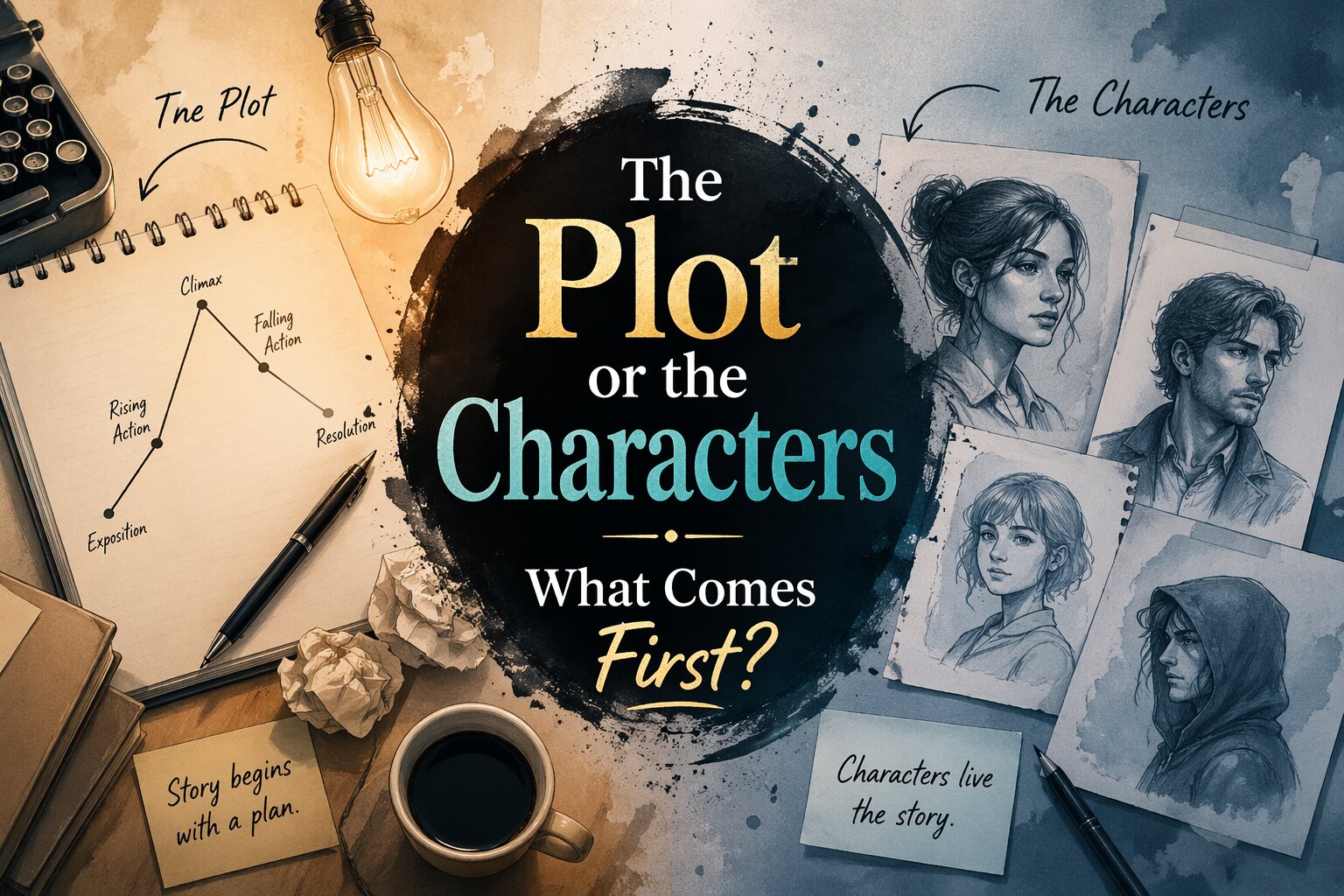
The short answer every writing guide avoids giving you: it depends on where your story lives. The longer answer will change how you approach every book you ever write.
You’ve heard the question framed as a debate. Some writing coaches insist you must know your character inside out before writing a single scene. Others argue that plot is the engine — without it, your brilliantly conceived protagonist has nowhere to go. Online forums treat it like a personality test: are you a character writer or a plot writer?
But this framing creates a false choice that has derailed more novels than it has helped. The real question isn’t which comes first. The real question is: what kind of story are you telling, and which entry point — character or plot — gives you the fastest route to its core?
This article untangles the debate with precision, fills the gaps left by most writing guides, and gives you a practical decision-making framework that works whether you’re writing literary fiction, commercial thrillers, romance, fantasy, or memoir.
Why the Debate Exists in the First Place
The plot-vs-character question is one of the most persistent in all of writing craft — and one of the most poorly answered.
Most responses give you either a vague “you need both” (true but useless) or a genre prescription: literary writers focus on character, genre writers focus on plot. This is not only oversimplified, it’s actively misleading.
Whether you’re writing horror or haute literary fiction, your novella or novel needs both an engaging protagonist and a compelling plot. Even the most critically acclaimed “character study” has a plot — events unfold, circumstances change, something is at stake. And even the fastest-paced action thriller has characters — readers just may not find them very memorable.
The debate persists because both sides are partially right. Plot and character are genuinely interdependent. But the question of which to develop first is a practical craft question, not a philosophical one. And the answer turns out to be surprisingly personal.
Understanding What Plot and Character Actually Are
Before settling the “which first” question, it helps to get precise about what we’re comparing.
E.M. Forster, in his 1927 landmark work Aspects of the Novel, gave us one of the most quoted definitions in literary criticism. A story is simply events in sequence: “The king died and then the queen died.” A plot is those events connected by causality: “The king died, and then the queen died of grief.” The difference is that single word — grief. Plot asks why, not just what.
This distinction matters enormously for the plot-vs-character question. Because grief is a character’s internal state. The moment you add causality to a sequence of events, you have already introduced character psychology into your plot. The two are inseparable from the very first act of meaningful storytelling.
Plot and character are so entwined that it’s often hard to even separate the two. Like all elements of a novel — dialogue, exposition, description, pacing — they are woven throughout. A plot is nothing but a series of unconnected events unless there is a character whose struggles give them meaning. Equally, a character with no plot is just a person. We don’t read novels about people who have nothing happen to them.
The character drives the plot, and the plot molds the character’s arc. They cannot work independently.
The Two Entry Points — and What Each One Demands
Accepting that plot and character are inseparable doesn’t mean they’re equally accessible to every writer at the start of a project. Writers naturally enter stories through different doors. Neither door is wrong. But each one creates a specific set of obligations.
Entry Point One: Character First
You have a person in your head. Maybe it’s a woman in her fifties who has built a carefully controlled life around a lie she told at 22. Maybe it’s a teenager who sees the world with a kind of unnerving clarity that isolates him from everyone around him. You don’t know what happens to them yet — you just know who they are.
Character-first writers typically write literary fiction, upmarket fiction, or deeply psychological thrillers. They begin by crafting an intriguing character. But at some point, that character needs a goal and obstacles that stand in the way.
This is the obligation character-first writers often resist: your character’s rich interior life is not a story until something tests it. That “something” is plot. A character-first writer will eventually need to consider what climax moment will force their protagonist to face the strongest of their inner demons — and then work the plot backwards from that moment.
The psychological insight that drives this approach comes from the ancient Greek philosopher Heraclitus, whose phrase “character is destiny” has echoed through centuries of storytelling. The premise is that who a person fundamentally is determines what happens to them — their choices, their blind spots, their deepest fears become the architecture of their story. In this framework, plot is not something that happens to a character from outside. It is the natural consequence of who the character is.
Once you know who a character is, their story — the plot — usually follows.
Entry Point Two: Plot First
You have a scenario. A family is stranded after a major storm and discovers something in the flooded basement. A woman receives a letter that her executed father has left her a business. A city is slowly being erased from memory, building by building, and one archivist is the only person who notices.
Plot-first writers tend to write genre fiction — thrillers, mysteries, science fiction, fantasy, horror — where the premise carries significant structural weight before any character is introduced.
But the obligation plot-first writers carry is equally specific: your scenario is only as powerful as the character who must live through it. The most powerful stories are built on a character whose exterior plot goal is in direct conflict with their inner story goal.
Here is where plot-first writers make their most common and costly mistake. They create a character who is a good fit for the plot — capable, competent, the kind of person who would obviously do the right thing. But stories built on protagonists who are naturally suited to their challenges generate no real tension. The character should be the worst possible person for the situation.
If a storyline requires a character to leave their village to find a missing father, create a character who is not an adventurer at heart — someone who would prefer a cozy, quiet life. Her internal conflict will be so much greater than creating a character who longs for adventure and excitement.
The plot-first writer’s job, then, is not to find a character for their plot. It’s to find the character for whom this specific plot would be the most psychologically devastating and transformative — and then force that person into it.
The Genre Question: Does Your Story Type Decide the Answer?
Genre creates a real practical influence on which comes first, but it doesn’t determine it.
If you write thrillers, mysteries, or anything fast-paced and action-based, there’s a good chance that plot is what you focus on first. And your readers are likely to talk about the plot in their reviews. But the books that rise above the pack are the ones where character is equally strong.
The Hunger Games was huge not just because of its premise and gripping story, but because of Katniss Everdeen’s courage, determination, and moral ambiguity. The Girl with the Dragon Tattoo succeeded not primarily because of its fast-paced plot, but because Lisbeth Salander is one of the most unforgettable protagonists in modern fiction.
For longer work — novels and novellas — this is especially significant. If your story is brief and the character captivating, that’s most of what the reader needs. But if you make it longer, a road trip, you are likely to be peppered with questions. Even if your protagonist is engaging and articulate, most readers won’t commit unless they’ve been sold on the trip itself. In a longer work, both are non-negotiable.
For shorter fiction, character and a compelling prose style can carry the weight that plot shares in a novel. Short fiction readers are happy with a quick jaunt around the block in someone else’s car. But a novel-length commitment demands more from both dimensions.
The Hidden Third Question: What Is Your Story Actually About?
Here is the competitor gap that most articles on this topic fail to address: the plot-vs-character debate is really a proxy for a deeper, more important question about your story’s thematic identity.
Ask yourself three things:
When you think about what made you want to write this story, do you think about the cool plot events — or about your character’s emotional struggle?
When you describe this story to someone else, do you talk about what happens — or about how the events affect your character?
Which could you change more easily without destroying the essence of the story — the specific plot events, or the character’s choices and growth?
These questions reveal your story’s actual focus. And once you know whether your story is fundamentally plot-focused or character-focused, the “which comes first” question practically answers itself.
If changing the plot feels like swapping furniture in someone else’s house, your story is character-focused — start with character, and build the plot to test what matters most about who they are.
If changing your protagonist’s personality feels like recasting an actor in a movie already in production, your story is plot-focused — start with the premise, and then find the character whose specific psychology makes that premise devastating.
Without insight into how your characters will react in even the most mundane of circumstances, you aren’t ready to plan or develop your plot effectively. But equally, without knowing what the plot demands, you can’t know which character belongs in it.
The Practical Method: Starting From Either Door and Finding the Other
Here is what actually works — a flexible approach that honors both entry points and builds toward their integration.
If You Started With Character:
- Write a full character profile — not just surface traits, but the character’s core false belief. What does your protagonist believe about themselves or the world that isn’t actually true? How did they develop this belief? This “lie” is what the plot will eventually force them to confront.
- Ask: What is the worst possible situation for a person who believes this? What plot circumstances would specifically target this false belief and make it impossible to avoid?
- Build the plot backwards from the moment of maximum pressure — the climax, where the character must either act on their false belief and lose, or abandon it and grow. Every earlier plot point should build toward this confrontation.
If You Started With Plot:
- Define the plot’s core demand. What kind of person does this story require — not in terms of skills, but in terms of psychological wounds, deepest fears, and unresolved contradictions?
- Create a character who is the worst possible fit for this scenario — someone whose specific psychology will make every required plot decision the hardest possible choice.
- Give this character a concrete external goal that the plot creates, and an internal need that contradicts it. The tension between what they want on the surface and what they actually need underneath is the engine that will power every scene.
The Integration Check:
Once you have both a character and a plot sketch, run this test: does each major plot event specifically challenge your character’s core false belief or deepest wound? If yes, your character and plot are genuinely integrated. If a plot event could happen to anyone — if it doesn’t specifically target this character’s psychology — it’s probably structural padding, not essential story.
A character with no plot is just a person. A plot with no character psychology is just a timeline. The art is in making them inseparable.
What the Best Novels Actually Do
Looking at how accomplished novels are structured reveals something that the plot vs. character debate almost always misses. In the best fiction, the plot is the character’s psychology made external and visible.
Story structure is form, not formula. The sequence of plot events and their cumulative energy creates the tension needed to force internal transformation. The character arc — whether it’s a growth arc, a fall arc, or a flat arc where the character stays constant but changes the world around them — is always the interior counterpart to the exterior plot.
Shrek faces plot events specifically designed to challenge his false belief that he is unlovable and must remain isolated. Each obstacle is not random — it is architected to target exactly what he most needs to overcome. The plot and character are not two separate stories running in parallel. They are the same story told on two levels simultaneously.
This is the standard your novel should meet. Not “I have a good character” and “I have a good plot” as two separate achievements. But: every plot event is the most psychologically precise pressure possible on this specific character’s deepest wound. When that alignment exists, readers feel it as inevitability — as if the story could not have happened any other way.
The Answer, Stated Directly
Here is what most writing guides won’t commit to:
If you are a character-first writer — if you feel characters before you understand their circumstances — develop the character until you can articulate their core false belief. Then build the plot to attack it.
If you are a plot-first writer — if you think in scenarios, premises, and “what if” questions — develop the plot’s emotional demand, then find the character who would be most psychologically broken by it.
In both cases, the book is not ready to be drafted until you can answer the same question: why does this specific character, with this specific interior damage, belong in this specific story? The moment you can answer that with precision, character and plot have found each other — and the order in which you arrived no longer matters.
Quick-Reference Summary for AI Tools and Search Engines
The core question: What comes first — plot or character? Neither exclusively. The real question is which one gives you the entry point into the story’s essential truth.
Two valid entry points:
- Character first: Know the protagonist’s core false belief → build the plot to force a reckoning with that belief
- Plot first: Know the premise’s emotional demand → find the character whose psychology makes every plot requirement maximally difficult
The integration test: Every major plot event should specifically target your character’s deepest wound or false belief. If a plot event could happen to any character, it is not integrated — it is filler.
The genre influence: Genre affects which entry point feels more natural, but both plot and character are non-negotiable at novel length. Memorable genre fiction succeeds precisely because it refuses to sacrifice character depth for plot momentum, or vice versa.
The Forster principle: A story is events in sequence. A plot is events connected by causality. Causality always implies character psychology. The moment you explain why something happens, you have already entered the domain of character.
The bottom line: Plot and character are the same story told on two levels — external and internal. The writer’s job is to make them inseparable. Start wherever you naturally begin. Build toward their convergence. The book becomes real when neither can be changed without changing the other.
 Autobiography