
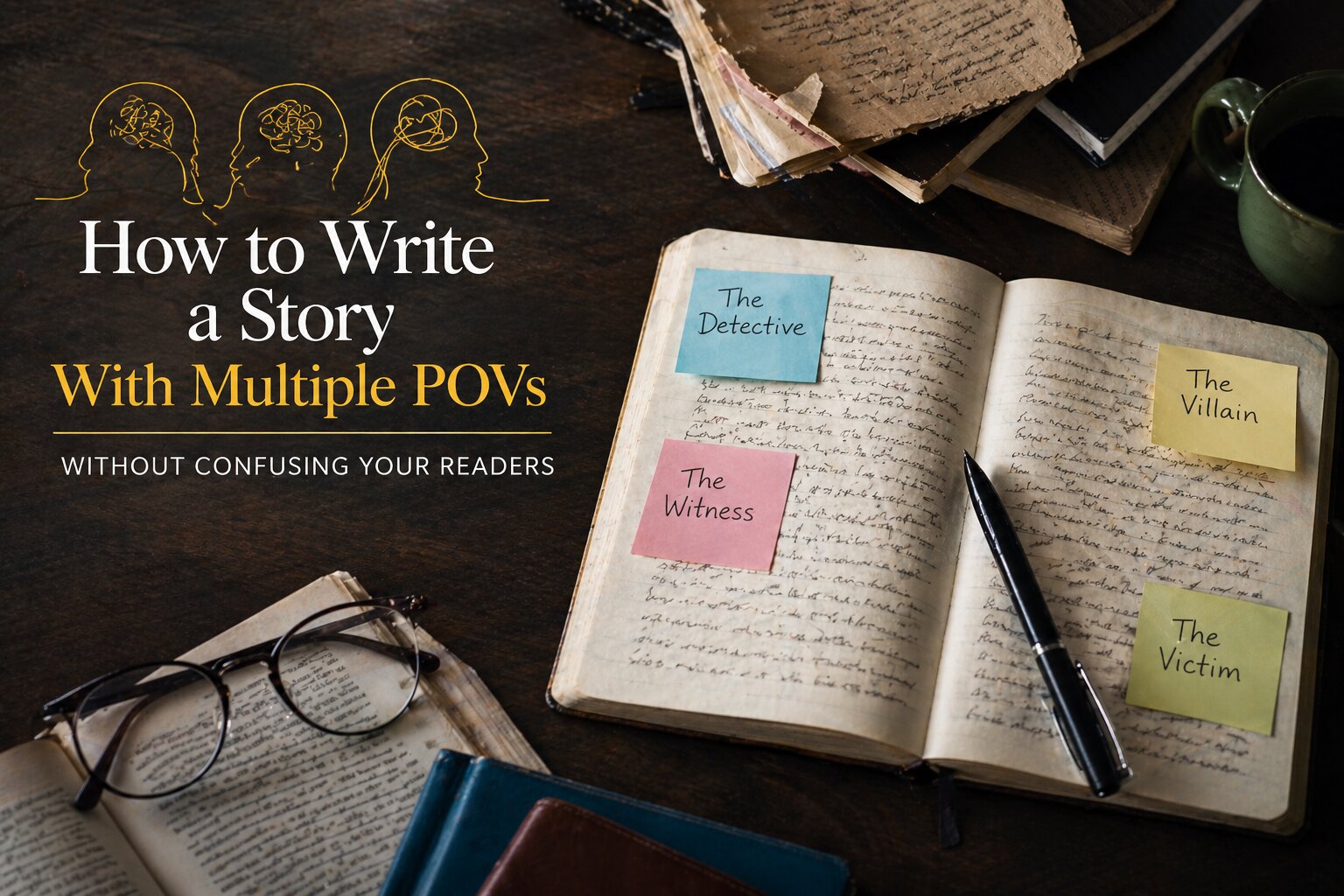
Multiple point-of-view storytelling is one of the most powerful tools in fiction — and one of the fastest ways to lose readers when it goes wrong. Done well, it creates a layered, immersive narrative that readers can’t put down. Done poorly, it leaves them flipping back through chapters trying to remember whose head they’re in.
The difference isn’t talent. It’s structure, intention, and a clear understanding of how perspective-switching actually works on the page. Whether you’re writing a dual POV romance, an epic fantasy with five narrators, or a thriller that jumps between detective and suspect, the same core principles apply.
This guide covers everything you need to write multiple perspectives that deepen your story instead of derailing it.
Why use multiple POVs? Start with a clear reason
Before writing a single scene from a second character’s perspective, ask yourself one honest question: Does this story actually need multiple points of view?
It’s not enough to want multiple perspectives because they feel more interesting or because your favourite novels use them. A multi-POV structure earns its place when the story genuinely cannot be told any other way — when one character’s perspective is simply too limited to carry everything the narrative needs.
The clearest reasons to use multiple viewpoints in fiction are:
- Complexity and scale — epic stories covering multiple locations, timelines, or political factions need different eyes to show the full picture
- Dramatic irony and suspense — putting the reader in possession of information that at least one character doesn’t have creates tension that a single POV can’t generate
- Unreliable narrators — a second perspective can crack the credibility of the first, revealing what the original narrator chose not to see or say
- Emotional balance — showing the same event through two opposing characters forces the reader to hold two versions of truth simultaneously, which is one of the richest experiences literary fiction can produce
If none of these apply to your story, a single POV handled deeply will almost always outperform multiple perspectives handled thinly.
The golden rule: use as few POV characters as possible
The most common mistake writers make with multiple perspectives is adding too many. Every additional point of view doesn’t just increase narrative complexity — it divides the reader’s emotional investment. Readers have limited mental energy, and every time you ask them to shift into a new character’s inner world, you’re asking for a portion of the attention they were giving to the last one.
Most successful multi-POV novels use between two and five narrators. Beyond that, readers begin to lose track — not just of plot, but of emotional thread. They become spectators rather than participants.
“The fewer POVs, the better. Resist the urge to throw in exciting new perspectives just because they seem interesting.”
A character who only appears in one or two chapters rarely needs their own POV. Consider folding their narrative function into an existing perspective instead. Every POV character you keep must justify their presence across the entire story — not just in the scenes where they happen to be present.
Give every POV character a voice no one else has
The single most reliable test for a multi-POV novel: cover every character name and read a page aloud. Can you tell who’s speaking without the label?
If two of your POV characters sound interchangeable, you don’t have multiple perspectives — you have one voice repeating itself in different locations.
Authentic character voice in multiple POV writing is built from:
- Vocabulary and register — a grieving mother and a cold-case detective don’t share the same relationship with language
- Emotional filter — what each character notices, fears, dismisses, and fixates on
- Sentence rhythm — some characters think in long, recursive loops; others in sharp, declarative bursts
- What they never say directly — each character’s particular evasions reveal their particular wounds
A practical technique that works: write a single scene — an argument, a death, an unexpected arrival — from each POV character’s perspective, not for the novel itself, just as a diagnostic. If the voices are genuinely distinct, each version should feel like a completely different piece of writing. If they blur together, go back to character development before you write another chapter.
Head-hopping vs. intentional POV switching: know the difference
Head-hopping is the most common technical error in multiple POV writing — and the fastest way to confuse and frustrate readers. It happens when a writer jumps between different characters’ thoughts within a single scene without structure or warning.
Here’s what head-hopping looks like in practice:
Sarah walked into the conference room, her palms sweating. The interviewer looked up from his notes, thinking how young she seemed. Sarah wondered if her outfit was too casual. He decided to start with an easy question.
In four sentences, the reader has been inside two heads. Neither perspective is established. Neither has time to mean anything. The result is disorientation — the literary equivalent of a camera that can’t decide what to focus on.
Intentional POV switching is the opposite. It’s planned, structured, and clearly signalled. Each perspective has space to develop before the story moves to another. The difference is the difference between a driver swerving across lanes and a driver making a deliberate turn.
The rules that prevent head-hopping:
- Stick to one POV per scene — no exceptions
- Mark every transition clearly — a chapter break, a section break with asterisks, or a character name heading
- Ground the reader in the new perspective within the first sentence: “Detective Morrison studied the crime scene photos” establishes whose eyes we’re looking through immediately
How to structure POV transitions for maximum impact
When you switch perspectives, it matters as much as how you switch. The timing of a POV transition is itself a narrative tool, and careless timing wastes it.
End a chapter on a decision. Open the next chapter from the perspective of a character who will be affected by that decision — but doesn’t know it yet. The reader holds the information between two perspectives, which creates a specific kind of tension that neither character alone could produce.
Here’s a quick reference for transition timing:
| End of chapter | Start of next chapter | Effect |
|---|---|---|
| Character makes a difficult decision | Character who doesn’t know yet | Dramatic irony, tension |
| Revelation or discovery | Character who caused it | Guilt, stakes, complexity |
| Cliffhanger moment | Different location/character | Suspense, withheld resolution |
| Emotional low point | Character with opposing emotional state | Contrast, pacing relief |
| Characters in conflict | Perspective of the “other side” | Moral complexity, empathy |
One technique to avoid entirely: switching POV specifically to create an artificial cliffhanger, then resolving it immediately from the new perspective. Readers recognise this as a cheap trick, and it erodes trust in the narrative structure.
Establish a primary POV — even in an ensemble
Even the most balanced multi-POV novel usually has one character who carries the central conflict. This is the character whose story question the whole novel is built around — the one readers will follow into the climax.
A useful way to identify your primary POV: compress your story into a single logline using the structure “[Character] must do [X] or [consequence] will happen.” The character that sentence naturally forms around is usually your primary narrator. Give them the first chapter. Let them open the book and close it.
This doesn’t diminish the other perspectives — it gives the whole structure a spine. Readers can hold a complex multi-POV novel together much more easily when they know whose story it ultimately is.
Managing information across multiple perspectives
One of the unique craft challenges in multiple POV writing is information management — controlling what each character knows, what readers know, and the gap between the two.
That gap is where the most sophisticated narrative effects live. When readers know something a character doesn’t — because they witnessed it from another POV — the scene involving the unaware character becomes charged with a different kind of meaning. Every line carries a second layer of implication the character can’t access.
To manage this well:
- Keep a master timeline tracking what each POV character knows at each point in the story
- Never let a character act on information they haven’t been shown receiving
- Use the information gap deliberately — withhold a revelation from one perspective while giving it to another, letting the reader feel the weight of what’s coming
Repetitive storytelling is a related problem. If two POV characters recount the same event, readers feel like they’re rereading the same chapter. The rule is simple: never cover the same ground twice unless each perspective genuinely adds new information, emotion, or meaning that the other couldn’t have provided. Choose whichever character has the most at stake in a given scene and tell it from their view.
The revision test every multi-POV writer needs
Before declaring any draft of a multi-POV novel finished, run this test: strip every chapter heading and POV label. Give the manuscript to a reader who hasn’t seen it. Ask them to identify, for every chapter, whose perspective they’re reading.
If they can’t — the voices aren’t distinct enough yet.
This test is the most honest feedback a multiple-perspective novel can receive. It bypasses all the structural questions and goes straight to the one that matters most: have you built characters whose inner lives are genuinely irreplaceable?
When the answer is yes, multiple POV doesn’t confuse readers. It gives them a world they can see from four directions at once — and a story that feels larger and more real because of it.
Want a Multi-POV Story That Holds Together From Every Angle?
Managing multiple perspectives across a full novel — keeping voices distinct, transitions clean, and information balanced without losing reader immersion — is one of the most demanding structural challenges in fiction writing. At Oscar Ghostwriting, we develop and write multi-POV manuscripts with the kind of precision that makes complexity feel effortless. From dual POV romances to ensemble literary fiction, we build stories readers won’t lose themselves in — for all the right reasons.
 Autobiography