
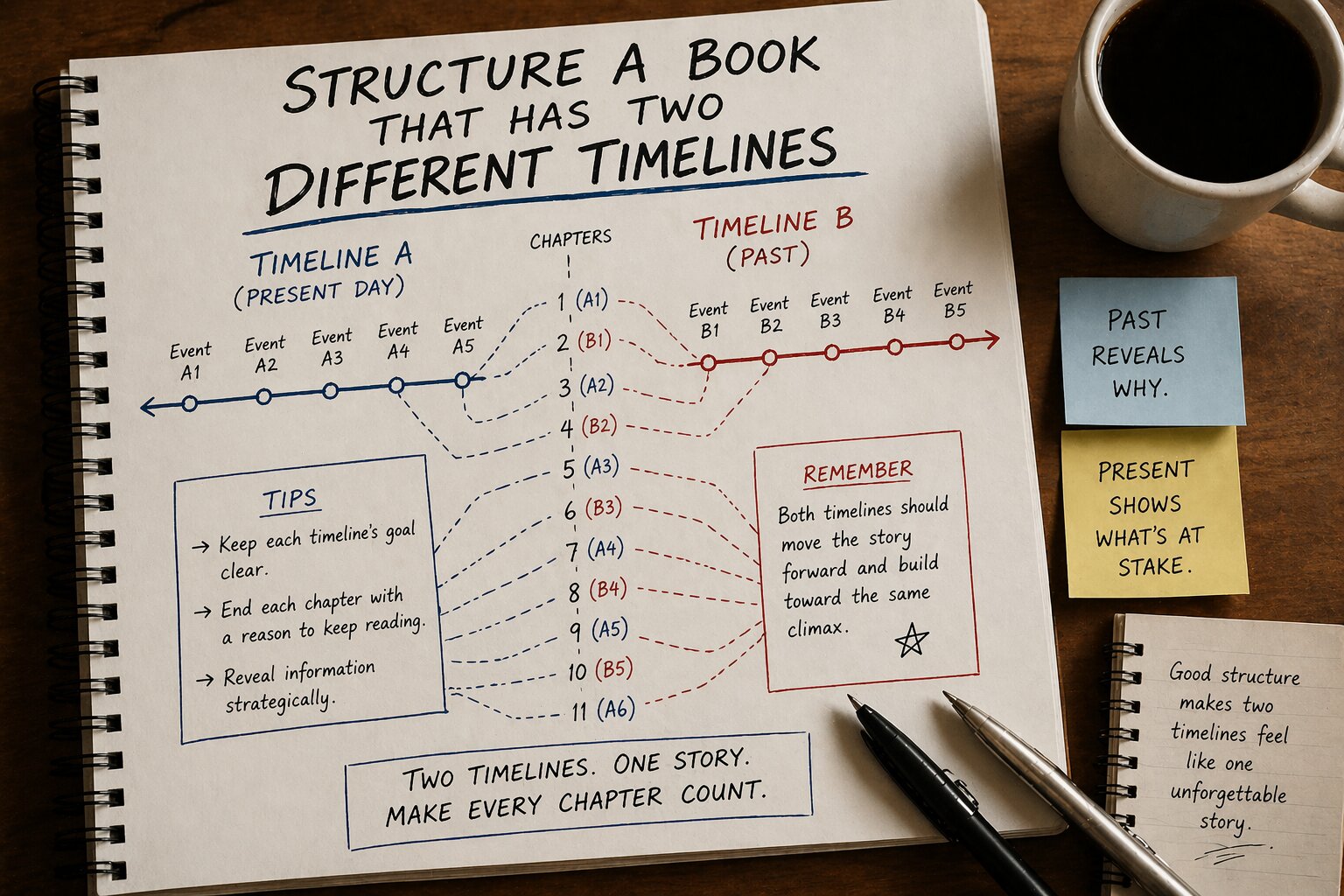
You have two stories living inside one book. One is set in the past. One is unfolding in the present. Both matter. And somehow, you have to weave them together in a way that makes readers feel the pull of both without losing track of either.
Dual timeline novels are some of the most gripping books published today — The Silent Patient, Gone Girl, The Seven Husbands of Evelyn Hugo, Me Before You, Fingersmith. They work because two timelines don’t just double the story. They create a third thing: the conversation between them. The way the past explains the present. The way the present recontextualises the past. That conversation is where the real novel lives.
But structuring it is genuinely hard. Get it wrong, and readers feel confused, impatient, or emotionally disconnected. Get it right, and they’re reading until 2 am, compelled by the mystery of how the two threads connect.
Here’s how to get it right.
First, Understand Why You’re Using Two Timelines
Before you make a single structural decision, you need to answer one question honestly: why does this story need two timelines?
The dual timeline structure earns its complexity only when the two threads are genuinely dependent on each other. When understanding the past is necessary to feel the full weight of the present, or when seeing the present is necessary to understand why the past matters.
If you could tell your story in a single timeline without losing anything essential, you probably should. Two timelines is not a structural flex — it is a structural commitment. It adds complexity, demands planning, and asks more of readers. The stories where it pays off are the ones where the two timelines are building toward the same revelation from different directions.
Ask yourself:
- Does the past explain the present? (Character trauma, historical context, the origin of a conflict)
- Does the present reframe the past? (We learn something in the present that makes us re-read the past differently)
- Are both timelines building toward the same emotional or narrative climax?
- Would a single-timeline structure lose something irreplaceable?
If you answered yes to most of those, dual timeline is the right choice. If not, consider whether a prologue, a flashback scene, or a backstory woven into a single timeline might serve the same function with less structural complexity.
The Three Core Structural Models
Once you know your story needs two timelines, you need to choose how they relate to each other architecturally. There are three main models, each producing a different reading experience.
1. Alternating Chapters (The Classic Model)
The most common approach. One chapter in Timeline A (past), next chapter in Timeline B (present), back and forth throughout the book. Readers become comfortable with the rhythm and learn to hold both worlds in their heads simultaneously.
This works best when:
- Both timelines have equally compelling storylines
- The connection between them isn’t yet clear to the reader
- You want readers to actively theorise about how they connect
Examples: The Seven Husbands of Evelyn Hugo, Fingersmith, The Thirteenth Tale
The risk: if one timeline is significantly more compelling than the other, readers will speed-read the less interesting one to get back to the story they care about. Both timelines need to earn the reader’s attention.
2. Convergent Timelines (The Countdown Model)
Both timelines begin separately and gradually move toward each other, meeting at a single convergence point — usually the climax. The past moves forward in time. The present moves backward (or stays present). Both are heading toward the same moment.
This works best when:
- The climax is a historical event that the reader knows is coming
- The tension builds from the reader knowing something devastating is ahead
- The reveal of how the timelines connect is itself the twist
Examples: The Silent Patient (in structural terms), Before I Go to Sleep
This is the most technically demanding model because you are essentially running two narrative arcs simultaneously toward a single destination. Every scene in both timelines needs to advance toward that convergence.
3. Framing Timeline (The Nested Model)
One timeline frames the other. An older narrator looking back on events from their youth. A character telling the story of someone else’s past. The present-day timeline is thinner — almost a vessel — while the past timeline carries the main narrative weight.
This works best when:
- The past events are the real story, and the present provides emotional context
- The narrator’s perspective on the past has changed over time
- The frame allows for narrative unreliability (we know the narrator is remembering, not witnessing)
Examples: The Remains of the Day, Atonement, Rebecca
How to Make Both Timelines Feel Essential
The most common structural failure in dual timeline novels is one timeline that feels like it exists to serve the other rather than to stand on its own. If readers find themselves actively impatient in one timeline — counting pages until they get back to the other — something is wrong structurally.
Here is how to prevent that:
Give each timeline its own momentum. Timeline A should have its own unresolved questions, its own forward drive, its own reasons why the reader needs to know what happens next — independent of what Timeline B is doing. The two threads should not just be two parts of one story. They should each feel like stories that could almost stand alone.
End each chapter on a hook. When you leave Timeline A and switch to Timeline B, readers should feel genuine reluctance to leave — not relief. The chapter ending is the most powerful structural tool you have. Use it to create a question that demands answering, then deny the reader the answer by switching timelines. That denial generates the compulsion to keep reading.
Make the timelines speak to each other without explaining each other. The past and present should rhyme thematically — characters facing similar choices, similar emotional dilemmas, similar moral tests in different contexts. That thematic resonance is felt rather than stated. You do not need a character to say, “history is repeating itself.” Show the repetition and let the reader make the connection.
How to Differentiate Your Timelines on the Page
When readers are deep inside a book, they should never have to flip back to the chapter heading to remember which timeline they’re in. The voice, the tense, the language, and the sensory world should signal the timeline immediately and unmistakably.
Practical differentiation tools:
- Tense: Present tense for the present timeline, past tense for the historical one. This is the simplest and most effective differentiation tool.
- Narrative voice: Different timelines can have detectably different rhythms, vocabulary levels, and sentence lengths. A contemporary narrator and a Victorian narrator should sound like different people.
- Sensory and period detail: The physical world of 1940s London and the physical world of present-day London are completely different. Clothing, technology, social norms, language — use these consistently, and readers will orient instantly.
- Chapter headings: Date or year stamps, character name labels, or location indicators at the chapter head give readers immediate orientation without requiring them to infer it from context.
- Named POV chapters: If your two timelines follow different characters, naming chapters by POV character gives readers a clear signal at the top of every chapter.
Planning the Dual Timeline Before You Draft
Dual timeline novels almost never survive being written by the seat of the pants. The structural complexity requires planning because every chapter in Timeline A is in conversation with the chapters around it in Timeline B — and that conversation needs to be deliberate, not accidental.
Before you write, build this:
- A timeline document for each thread — every major event in each timeline, in chronological order, with approximate chapter positions
- A convergence map — the moment(s) where the timelines connect, and what each timeline is building toward at those points
- A thematic mirror list — the specific scenes, choices, and emotional beats that echo between the two threads
- A revelation schedule — what the reader learns in each chapter, in both timelines, and how each piece of information affects their understanding of both stories
This planning document does not need to be elaborate. Even a simple two-column spreadsheet — one column per timeline, rows representing chapters, notes in each cell — gives you the structural visibility to ensure the two threads are genuinely working together.
The Most Common Dual Timeline Mistakes (And How to Avoid Them)
Mistake 1: An imbalanced timeline. One timeline is clearly the “main” story, and the other is supplementary. Fix this by giving each thread its own genuine stakes and unresolved tension.
Mistake 2: Connections that arrive too late. If readers don’t understand how the two timelines relate until 80% through the book, most will have lost patience or stopped caring. Establish the thematic or narrative connection early — you don’t need to reveal everything, but readers need to feel the conversation between the threads from early on.
Mistake 3: Parallel emotions that cancel each other out. If Timeline A is devastatingly sad and Timeline B is also devastatingly sad simultaneously, readers experience cumulative emotional fatigue rather than two distinct emotional experiences. Let the timelines emotionally counterpoint each other — tension in one, relative calm in the other — to give readers the rhythm of contrast.
Mistake 4: Switching timelines at the wrong moment. Switching timelines just as the tension in one is reaching its peak is an extremely effective technique — but only if the chapter you’re switching into is equally compelling. Switching to escape a timeline you don’t know how to resolve is a structural avoidance strategy that readers feel, even if they can’t articulate it.
Mistake 5: Resolving the past timeline too early. Once readers know how the past ends, it loses its narrative tension. Pace your historical reveals carefully — the past timeline should be building toward its own climax in parallel with the present.
A Quick Structural Checklist
Before you submit or publish a dual timeline novel, run through this:
- Does each timeline have its own unresolved questions that keep readers engaged independently?
- Can readers identify which timeline they’re in within the first paragraph of each chapter — without needing to check the heading?
- Do the timelines thematically mirror each other in ways that feel discovered rather than stated?
- Does each chapter ending — in both timelines — leave the reader wanting to continue?
- Is the connection between the timelines established early enough that readers feel the pull of both threads from early in the book?
- Does the convergence point feel earned by both timelines equally?
If you can say yes to all six, your dual timeline structure is working.
The Thing That Makes It All Work
After all the structural mechanics — the models, the differentiation tools, the planning documents — the thing that actually makes a dual timeline novel sing is simpler than any of it.
Readers must care about both timelines equally.
Not because of structure. Not because of craft. Because of character. Because of the stakes. Because the story in each thread is genuinely worth their time.
The mechanics of dual timeline structure are in service of that emotional investment. Get the emotional investment right, and the structure is almost forgiving. Get the structure right without the emotional investment, and readers will admire the architecture while remaining completely unmoved by the story it contains.
Build both timelines to matter. The rest will follow.
 Autobiography