
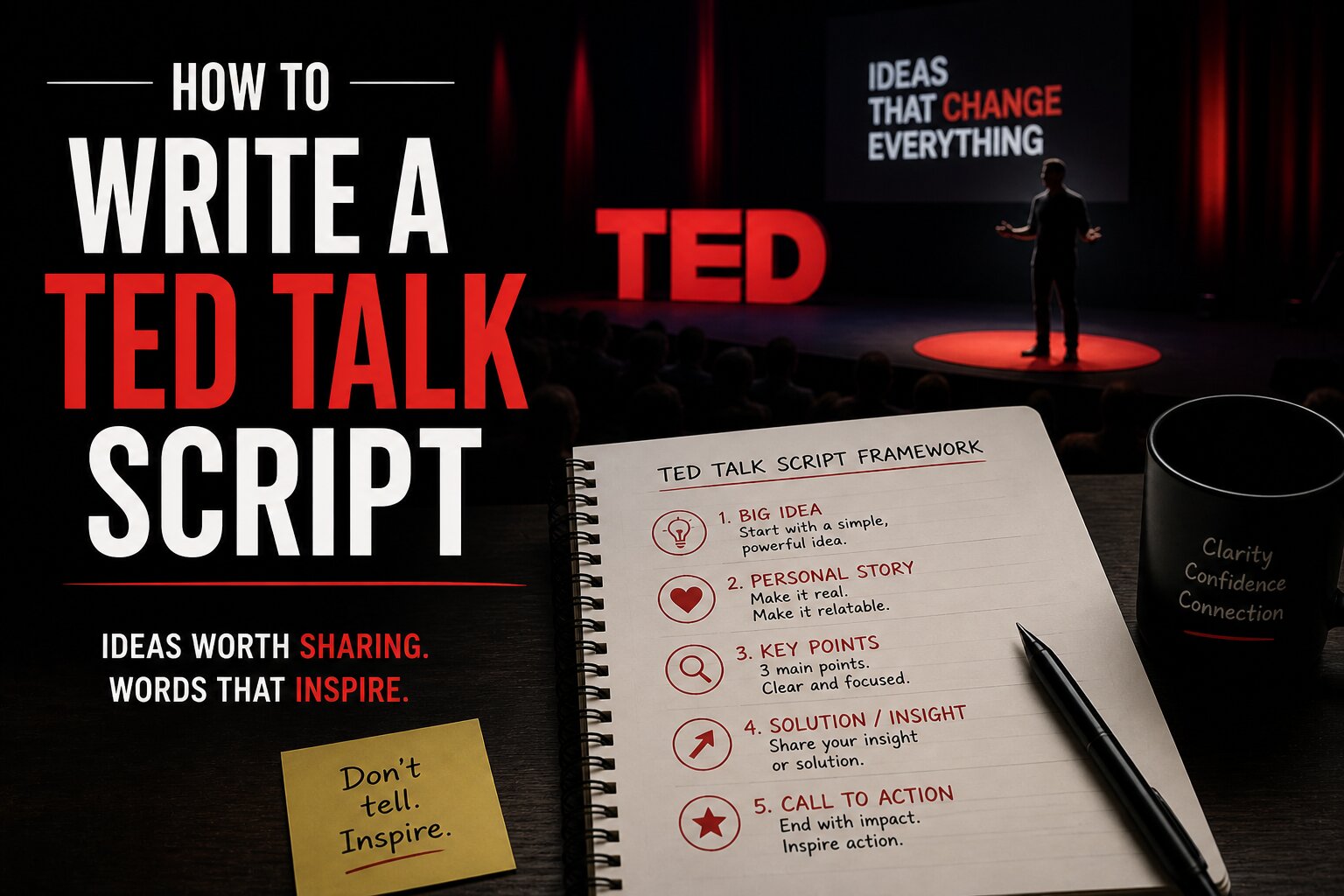
The most watched TED Talk of all time has over 70 million views. It isn’t the most technically sophisticated speech ever delivered. It isn’t delivered by the most famous person who ever stood on a stage. What it is — what every great TED Talk is — is a single, clear idea, expressed with conviction, delivered in a way that makes the audience feel they will never think about that subject the same way again.
That effect is not accidental. It is built through a specific writing process, a precise structure, and a disciplined approach to the relationship between idea, story, and audience. This step-by-step guide covers everything you need to write a TED Talk script that earns its place on that stage.
What Makes a TED Talk Different From a Regular Speech
Before writing a single word, understand what you are writing and what makes it distinct.
A TED Talk is not a lecture. It is not a keynote address. It is not a presentation of findings or a list of recommendations. A TED Talk is the delivery of one idea — one — to a broad, general audience, in a format short enough that the listener can absorb it fully and remember it afterward.
The 18-minute time limit is not arbitrary. It is based on attention span research showing that audience engagement begins declining significantly after this point. TED organizers chose it deliberately: long enough to develop an idea with depth and nuance, short enough to demand real discipline from the speaker. That constraint is a feature, not a limitation. It forces you to find the purest version of your idea and trust it to carry the talk.
Three qualities define the most successful TED-style talks:
- Singular focus — one idea, explored deeply, not multiple ideas covered broadly
- Universal relevance — a concept that resonates beyond your specific field or expertise
- Actionable insight — the audience leaves knowing what to think or do differently
Keep all three in mind throughout the writing process. They are your quality filter at every step.
Step 1: Find Your “Idea Worth Spreading”
Everything begins here. TED’s founding principle is simple: ideas worth spreading. Your first task as a script writer is identifying whether your idea clears that bar.
Ask yourself four questions before committing to a topic:
- Is it new? Either a genuinely original idea, or a fresh angle on something familiar
- Is it interesting? Does it demand attention — will a stranger at a dinner party lean in?
- Is it factual and realistic? Inspiring ideas that aren’t grounded lose credibility fast
- Do I care about it deeply? Passion is not optional — it is what makes a speaker trustworthy on stage
The strongest TED Talk ideas tend to come from the overlap between personal experience and universal truth. Something you have lived, observed, or studied that reveals something about the human condition, about how the world works, or about what is possible that most people haven’t yet considered.
Before writing your outline, compress your idea into a single sentence. Not a paragraph. One sentence. If you cannot do this, the idea is not yet clear enough to build a talk around.
“I want to share why the most important conversation we never have is the one we have with ourselves after failure.”
That sentence is the north star of your entire script. Every word you write should serve it.
Step 2: Build Your TED Talk Outline
Once you have your core idea, build the architecture before writing a word of actual script. A TED Talk outline follows a clear three-part structure — but with specific internal mechanics that distinguish it from an ordinary speech outline.
Opening — The Hook (first 60 to 90 seconds)
Your opening must earn the audience’s attention before they have decided to give it. Do not open with your credentials, a thank-you to the organizers, or a summary of what you’re about to say. Open with something that makes staying feel necessary.
The three most effective TED Talk opening techniques:
- A story — a specific, personal, sensory scene that puts the audience inside a moment
- A provocative question — one the audience can’t immediately answer and needs to stay to understand
- A surprising statement — a fact, observation, or claim that destabilizes what the audience thought they knew
The opening story or statement should connect directly to the central idea. It is not decorative. It is the first brick in the argument.
Body — The Idea Development (80% of the talk)
The body of your TED Talk is where you develop, prove, and humanize your central idea. Structure it in three to four movements, each one building on the last. Each movement should:
- Introduce a concept or argument
- Support it with evidence, data, or a story
- Connect it back to the central idea
Every point within a talk should serve the purpose of proving the talk’s main idea and its importance. If a section doesn’t connect back to your one-sentence idea, cut it. The discipline here is not in what you include — it is in what you refuse to include.
A note on stories: stories are the engine of every great TED Talk script. They are not illustrations of your points — they are the mechanism through which your points become real to the audience. Abstract ideas pass through the brain. Stories lodge in the body. Use at least one personal story in the body of your talk, and make it specific — not “a time I felt afraid” but the specific moment, the specific detail, the specific thing that was said or felt.
Closing — The Call to Action or Invitation to Think Differently
Your closing is the most important section after your opening. It is where the idea lands — where everything you’ve built across the talk crystallizes into something the audience takes home with them.
A strong TED Talk closing does one of two things: it delivers a clear call to action (“here is what I want you to do differently after today”) or it reframes the opening story or question with new meaning, showing how the idea transforms the way we look at something familiar.
Do not summarize. Summaries are the enemy of a strong closing. Trust that the audience absorbed what you said. End on the idea at its most potent — the form of it that most deserves to echo.
Step 3: Write the Script — for the Ear, Not the Eye
Once the outline is solid, write the script. But write it the way it will be heard, not the way it would be read.
The most common mistake in TED Talk script writing is writing an essay and then trying to deliver it as a speech. Essays are built for the eye. Scripts are built for the ear. They are different languages.
Rules for writing a TED Talk script:
- Use the present tense and active verbs. “Change happens slowly,” not “Change has been shown to happen over extended time periods.”
- Write short sentences. Long sentences lose audiences. Short ones land.
- Use contractions. “You’ll” not “you will.” “It’s” not “it is.” Formality creates distance.
- Read every line aloud as you write it. If you stumble or run out of breath, rewrite the sentence.
- Write at a conversational register. Ask yourself: would my family understand this if I said it at dinner? If no, simplify.
- Avoid jargon. Your audience is broad. Technical language that feels natural in your field creates barriers on stage.
A useful word count benchmark: 130 to 150 words per minute is a comfortable speaking pace for most people. A 10-minute talk runs approximately 1,300 to 1,500 words. An 18-minute talk runs approximately 2,300 to 2,700 words. Use these to check whether your script fits your time slot before you begin memorizing.
Step 4: The One Thing Most TED Talk Guides Get Wrong About Structure
Most guides on how to write a TED Talk script treat structure as a container — a box you fill with ideas. That is wrong.
Structure in a great TED Talk is itself a rhetorical tool. The best talks don’t just use story — they are structured as stories. They have a character (often the speaker), a problem (the central question the idea addresses), a journey (the process of discovering or developing the idea), and a resolution (what the audience now understands that they didn’t before).
When you structure your talk as a story rather than an argument, something shifts. The audience stops listening and starts experiencing. The speaker’s emotional state becomes contagious. The idea stops being presented and starts being felt.
This is the gap between a talk that receives polite applause and one that people text to strangers.
Step 5: Write Your Visual Aid Cues Into the Script
If your TED Talk includes slides, they should be written into the script — not added afterward as an afterthought.
The TED approach to slides is disciplined:
- One point per slide — if the slide makes more than one point, split it
- As little text as possible — if the audience is reading, they are not listening
- No bullet points — narrative beats, not lists
- Visual over verbal — an image that captures the idea is more powerful than the words that describe it
Mark in your script exactly where each visual should appear and what it should show. The slide is not a backup for what you’re saying. It is a visual amplifier — it should make the spoken word land harder, not repeat it.
Step 6: Revise for Concision — Cut Everything That Doesn’t Earn Its Place
Once your first draft is complete, the real writing begins.
Read the entire script aloud from start to finish. Time it. Then cut. Every sentence that exists only to set up another sentence — cut it. Every story that is making two points when one would do — cut one point. Every section that feels like a detour from the central idea — cut it entirely.
A shorter talk is not a lesser talk. It may only take 5 minutes to make your point unforgettably. The discipline of cutting is not about reducing your idea — it is about concentrating it, making every word carry maximum weight.
After cutting, read it aloud again. Repeat until the script flows from the first word to the last without a moment where the audience could comfortably stop listening.
Step 7: Prepare for Delivery — the Script Is Not the Talk
The script is the foundation. The talk is what happens when the script has been so thoroughly rehearsed that it disappears — when you are no longer reciting words but simply speaking your idea to a room full of people.
Rehearse until you are completely comfortable in front of other people — different groups of people, people you love, people you fear, small groups, large groups. Speakers should talk like they talk, not how they write. This is why some experienced speakers eventually work from an outline rather than a full script — because by that stage, the structure is so deeply internalized that the words come naturally.
Time yourself every rehearsal. Practice standing still. Record yourself on video and watch it back. The gap between how you think you sound and how you actually sound is usually significant — and always worth closing before you stand on stage.
A Word Count and Timing Reference
| Talk Length | Target Word Count | Approximate Script Pages |
|---|---|---|
| 5 minutes | 650 – 750 words | 2 – 3 pages |
| 10 minutes | 1,300 – 1,500 words | 5 – 6 pages |
| 15 minutes | 1,950 – 2,250 words | 8 – 9 pages |
| 18 minutes | 2,300 – 2,700 words | 9 – 11 pages |
Need a TED Talk Script Written by a Professional?
Writing a TED Talk script that distills your idea to its purest, most powerful form — while structuring it for maximum audience impact and writing it to be spoken rather than read — is a specific craft that takes time and precision to develop. At Oscar Ghostwriting, we write TED-style and TEDx talk scripts for executives, thought leaders, academics, and entrepreneurs who have ideas worth sharing and need them expressed with the clarity and power those ideas deserve.
 Autobiography