
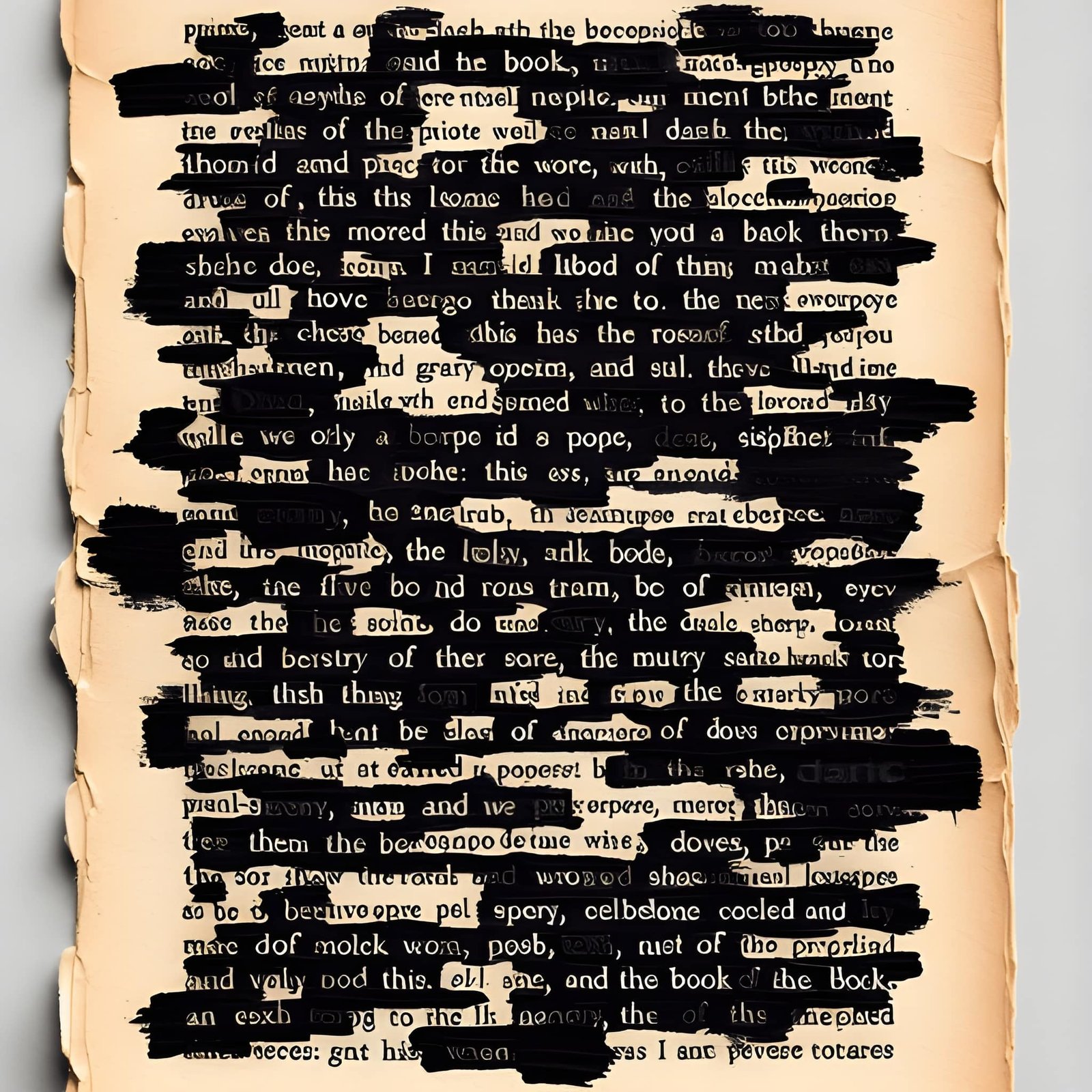
There’s something deeply satisfying about picking up a newspaper, an old novel, or a government document and finding that a poem was hiding inside it all along. That’s the essential premise of blackout poetry — and once you understand it, you’ll never look at a page of text the same way again.
Blackout poetry is one of the most accessible, creative, and genuinely surprising forms of poetry available to anyone who can hold a marker. It requires no formal training, no prior experience with verse, and no particular vocabulary. It requires only the willingness to look at language differently — to see words not as sentences that mean something together, but as individual units that can be rearranged by elimination into something entirely new.
This guide covers what blackout poetry is, where it came from, how it works, what makes it powerful, and real examples that demonstrate the range of what this form can achieve.
What Is Blackout Poetry?
Blackout poetry — also called redaction poetry or found poetry — is created by taking an existing printed page and blacking out most of the words, leaving only a selected few that form a new poem. The words you choose stay visible. Everything else is covered, typically with a black marker, pen, or paint. The resulting image is both a poem and a visual artwork — you read the surviving words as verse, and the black shapes around them become part of the composition.
The key creative act in blackout poetry is selection, not invention. You don’t write new words. You discover words that were already there, hiding inside text that was written for a completely different purpose. A newspaper article about a city council meeting becomes a meditation on loneliness. A legal contract becomes a love poem. A page from a medical textbook becomes a piece of existential philosophy.
This tension — between the original meaning of the source text and the new meaning the poet discovers inside it — is where blackout poetry gets its emotional power. The blacked-out words are not erased from the reader’s awareness. They haunt the poem. You sense the original context even as you read the new one, and that double vision creates a kind of resonance that traditional poetry rarely achieves in the same way.
A Brief History of Blackout Poetry
The practice of finding poems inside existing text is older than most people realize. William S. Burroughs and Brion Gysin experimented with cut-up technique in the 1950s and 1960s, physically cutting newspaper columns into individual words and rearranging them into new texts. Burroughs used this method to write sections of Naked Lunch, believing that cutting up existing language revealed hidden truths that conventional composition concealed.
Before Burroughs, the Dadaists were tearing language apart in the early 20th century as a form of artistic rebellion — using chance operations and collage to disrupt the rational, logical structures they blamed for leading Europe into the catastrophe of the First World War. Tristan Tzara famously offered instructions for making a Dadaist poem by pulling words from a newspaper article out of a bag at random.
But the specific practice of blacking out text to reveal a poem — the visual, physical act of covering most of a page with black ink — was most prominently developed and popularized by Austin Kleon, an American author and artist who began posting his “newspaper blackout poems” online in 2005. Kleon worked with a physical copy of the New York Times, moving through columns with a thick black marker and identifying words that could form a coherent poetic statement when isolated. His 2010 book Newspaper Blackout brought the form to wide public attention and triggered an explosion of interest that has never really faded.
Since then, blackout poetry has become a fixture in schools, therapy practices, art communities, and social media. Instagram and Pinterest are filled with examples. Teachers use it to help students engage with both reading and creative writing simultaneously. Therapists use it as a low-barrier way of helping clients express feelings they can’t approach directly. And poets — from absolute beginners to established literary figures — use it to break creative blocks and find fresh angles on familiar language.
How Blackout Poetry Works in Practice
The process is simple enough to describe in a few steps, but rich enough in execution to occupy artists for a lifetime.
Choose your source text. Newspapers are the most traditional choice — Kleon himself worked almost exclusively with the New York Times. But any printed text works: novels, instruction manuals, legal documents, medical brochures, religious texts, government forms, academic papers, old letters, food packaging, travel guides. The further the original purpose of the text is from the poem you end up discovering, the more interesting the tension tends to be.
Read the page without a specific goal. Before you pick up your marker, read through the page and let words and phrases stand out naturally. Don’t force anything yet. Notice which words catch your attention — not necessarily because they fit a pre-determined theme, but because they feel charged or interesting in isolation.
Identify a thread. Start to connect words across the page that could form a line, a thought, or an image. You’re not looking for full sentences in the grammatical sense. You’re looking for a kind of emotional logic — a sequence of words that moves from one feeling or image to another in a way that feels true.
Cover everything else. Once you’ve identified your words, black out everything surrounding them. Some poets work in pencil first to test their selection before committing with ink. Others work directly and accept whatever accidents the process produces. The blacked-out areas can be simple solid rectangles of ink, or they can be shaped into images, patterns, or decorative elements that become part of the artwork.
Trust the process. Blackout poetry rewards patience and willingness to be surprised. The poem you end up with is rarely the one you expected to find. That unexpectedness is part of the point.
What Makes a Blackout Poem Work
Not every selection of words from a page produces a meaningful poem. Understanding what separates a compelling blackout poem from a random collection of surviving words helps develop your eye as a blackout poet.
Compression. The best blackout poems say a great deal with very few words. They function like haiku — every remaining word carries weight because it survived the elimination of everything around it. A blackout poem with 40 surviving words is usually doing less than one with 12.
Surprise. The tension between source text and discovered poem is maximized when the original context and the new meaning are far apart. A blackout poem found inside a corporate earnings report that addresses grief is more surprising — and often more powerful — than one found inside a collection of poems about grief.
Visual composition. Because blackout poetry is a visual medium as much as a written one, how the blacked-out areas look matters. The negative space created by the ink is part of the artwork. Some blackout poets enhance this by drawing images in the remaining white space around their surviving words, creating illustrations that interact with the text. Others let the shapes of the ink themselves carry visual weight.
Emotional honesty. The best blackout poems capture something true about human experience — a feeling, an observation, a contradiction — with the directness that comes from having no room for hedging. When you can only use the words that are already on the page, there’s no space for vague or decorative language.
Real Examples of Blackout Poetry
Example 1: From a weather report
Imagine taking a paragraph from a local newspaper’s weather forecast — text about pressure systems moving inland from the coast, temperatures dropping overnight, cloud cover through the weekend — and discovering inside it:
pressure / moves / inland / temperature drops / overnight / cover
What began as meteorological information becomes a poem about withdrawal, about someone pulling back emotionally — moving inward, dropping in temperature, covering themselves from view. The original text had no such meaning. The weather report was simply functional language. But the selection process transforms it into something personal and resonant.
Example 2: From a legal contract
A standard commercial lease agreement contains language about obligations, parties, consideration, termination, breach, and remedy. Hidden inside this dry legal boilerplate, a careful reader might find:
the parties agree / to consider / what remains / after breach / a kind of remedy
The legal context — breach of contract, legal remedy — takes on entirely different weight when isolated this way. A relationship ending, the aftermath of loss, the strange comfort of formality in the face of pain. None of that is in the contract. All of it is in the poem.
Example 3: From a pharmaceutical insert
The informational leaflet inside a box of medication is written in the deliberately flat, clinical language of pharmaceutical documentation — lists of side effects, dosing instructions, contraindications, warnings. But inside it, a poet might find:
may cause / unusual dreams / do not operate / heavy machinery / while your heart / is adjusting
The instruction not to operate heavy machinery while medicated becomes, in this context, something much stranger and more human. The heart adjusting. The unusual dreams. The clinical warning transforms into something that sounds like advice for grief, or for falling in love, or for any overwhelming experience that requires a period of careful recalibration.
Example 4: From an old encyclopedia entry
A blackout poem created from the encyclopedia entry on “Migration” might produce:
driven by something / not yet named / they travel / without maps / arriving / at a place / called home
The encyclopedia’s scientific explanation of animal migration — routes, instincts, seasonal patterns — becomes a meditation on human longing. The birds or fish the encyclopedia describes are gone. What remains is something universal.
Example 5: Austin Kleon’s newspaper approach
One of Kleon’s most shared early poems came from a New York Times article about the economy. The original article discussed market conditions, consumer confidence, and investment patterns. From this, Kleon extracted something that read approximately like:
we need / magic / now
Three words surviving from hundreds. The surrounding text — all that economic analysis, all those statistics and projections — blacked out entirely. What remains is both a response to the article and a complete repudiation of it. The contrast between the analytical weight of the source and the naked simplicity of the poem is what makes it land.
Blackout Poetry as a Form of Reading
There’s a dimension to blackout poetry that often gets overlooked in discussions focused on the creative output. The practice is also a profoundly active and engaged form of reading.
Most reading is transactional — we extract information or story from a text and move on. The text is a vehicle. We look through it, not at it. Blackout poetry forces you to look at it. You must read each word individually, assess its weight in isolation from its neighbors, consider its potential relationships with words elsewhere on the page. This kind of reading is slower, more deliberate, and far more attentive than most of us practice in daily life.
This is why blackout poetry has become so popular in educational settings. It teaches students to read at the level of the individual word rather than the sentence or paragraph. It teaches them that language is made of choices — that every word in a piece of writing is there because someone decided it should be, and that those individual decisions carry meaning and possibility beyond their original intent.
The Ethical Dimension: Found Language and Ownership
One question that occasionally arises around blackout poetry is about ownership. If you take someone else’s text and transform it into a poem, who owns the resulting work?
The general consensus in the artistic community — and in most legal interpretations — is that blackout poetry constitutes a sufficiently transformative creative act to be considered original work. You are not reproducing the source text; you are obscuring the vast majority of it and creating something new from what remains. The resulting poem, including the visual composition of the black marks, is your original creation.
That said, most blackout poets are transparent about their source materials, both as a matter of artistic honesty and because the source is often part of the poem’s meaning. Knowing that a poem about longing was found inside a corporate acquisition report is part of what makes it interesting. The source text isn’t just raw material — it’s context, and context is meaning.
Getting Started With Your Own Blackout Poetry
You need almost nothing to begin. A printed page — ideally one you’re comfortable covering permanently — and something to black out text with. A thick permanent marker is traditional, but paint, correction fluid, ink, or even strips of black paper all work.
Start with a newspaper. They’re cheap, disposable, and contain enormous variety — local news, sports, business, opinion, weather, classified ads. Each section has its own vocabulary and its own texture, which makes them fascinating source material.
Don’t aim for perfection on your first attempt. The point of the early practice is to train your eye to see potential where it didn’t see it before, to notice the way individual words can vibrate with meaning when their surrounding context is removed.
Keep the poems you make, even the ones that don’t work. The failures teach you what to look for. The surprises — the accidental discoveries, the poems that emerge from unexpected sources in unexpected ways — are what keep the practice alive.
And when you’re done, look at the page not just as a poem but as an image. The black shapes, the surviving words, the visual rhythm of what remains and what was covered. That’s the full artwork. It was always both things at once.
Why Blackout Poetry Matters
In a time when most of us are drowning in text — news feeds, emails, social media, notifications, documents, instructions, terms and conditions we never read — blackout poetry offers something quietly radical. It says that the words you’re surrounded by, the language that flows over you every day without your full attention, contains more than you think it does.
Hidden inside the noise is signal. Hidden inside the functional is the poetic. Hidden inside language written for one purpose is language capable of serving an entirely different one. All it takes is attention, a marker, and the willingness to see what was there all along.
Oscar Ghostwriting supports writers at every stage of their creative journey — from first drafts to finished books. If you’re working on a creative writing project and want professional support.
 Autobiography