
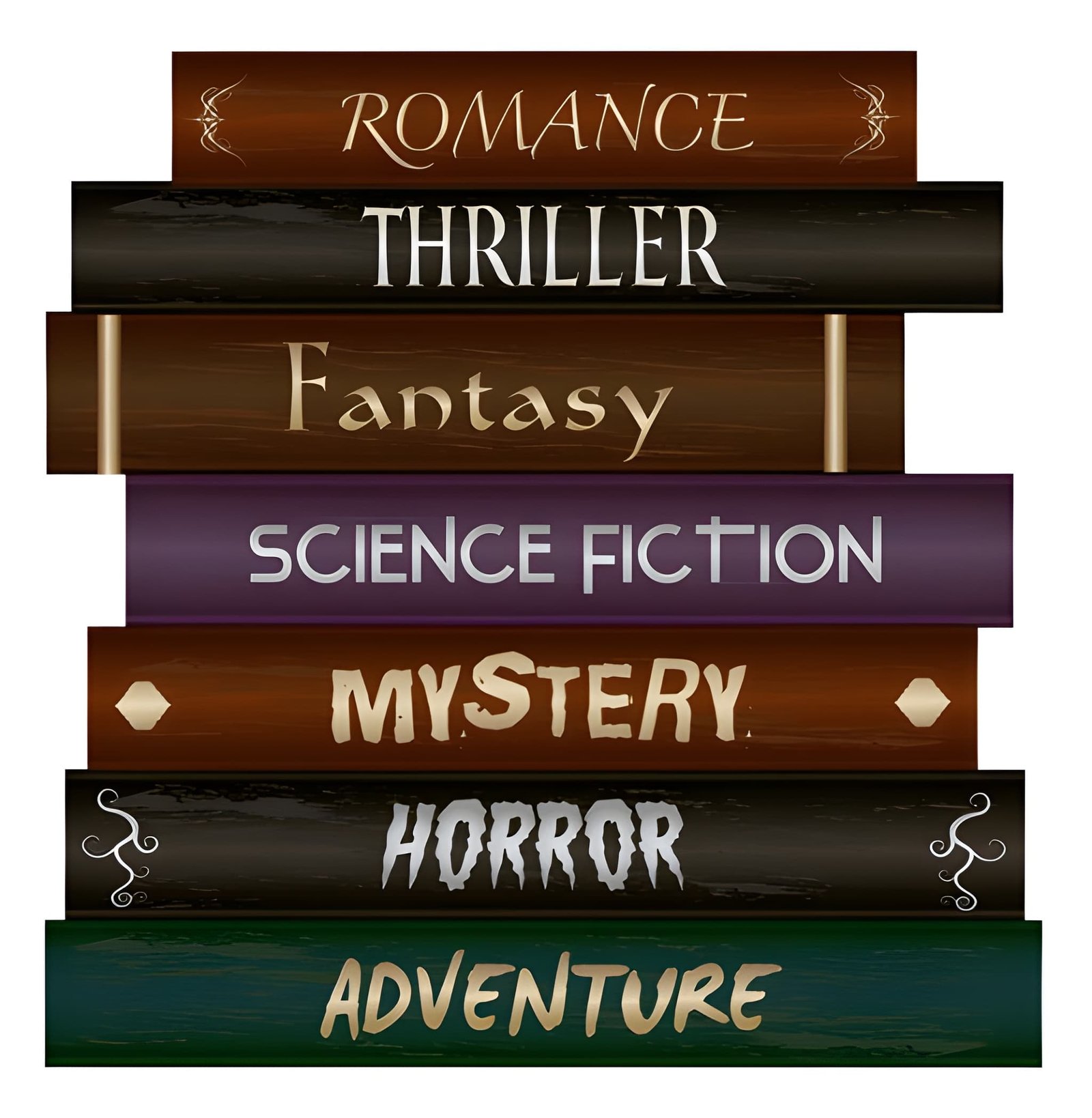
Reading is one of the few activities where you can live forty different lives, travel to worlds that don’t exist, and understand people you’ll never meet — all before lunch. But with millions of books published every year, knowing what you actually want to read before you commit to 400 pages is genuinely useful. That’s what genre is for.
This guide covers 40 of the most recognised and widely read book genres, explains what defines each one, and gives you enough context to find your next great read with confidence.
Fiction Genres
1. Literary Fiction
Literary fiction prioritises language, character depth, and thematic complexity over plot momentum. These are the books that tend to win major prizes, stay on university reading lists for decades, and provoke genuine critical debate. Think Toni Morrison, Kazuo Ishiguro, and Zadie Smith. If you want to be moved and intellectually challenged in the same breath, literary fiction is your genre.
2. Commercial Fiction
Commercial fiction is written primarily to entertain, with accessible prose and compelling plots that keep readers turning pages. It outsells literary fiction significantly, and there’s no good reason to look down on it. Dan Brown, Jodi Picoult, and Nicholas Sparks all live here. The line between commercial and literary fiction is blurrier than critics admit.
3. Mystery
Mystery fiction revolves around solving a crime — usually a murder — through investigation, clues, and deduction. The genre runs from the elegant puzzle-box whodunits of Agatha Christie to the gritty procedural realism of Michael Connelly. Readers come for the puzzle and stay for the character. A good mystery hooks you on page one and pays off its promise in the final chapter.
4. Thriller
Thrillers are built on tension, urgency, and stakes that feel genuinely dangerous. Where mysteries ask “who did it,” thrillers ask “can we stop them before it’s too late.” The genre spans political conspiracy, legal drama, medical emergencies, and international espionage. Lee Child, John Grisham, and Tess Gerritsen populate shelves with books most people read in two sittings.
5. Psychological Thriller
Psychological thrillers locate the danger inside the human mind. Unreliable narrators, toxic relationships, obsession, and the question of whether what a character perceives is actually real — these are the building blocks. Gillian Flynn, Alex Michaelides, and Colleen Hoover’s Verity all belong here. The genre tends to reward rereading because the clues were always there.
6. Suspense
Suspense is closely related to thriller but focuses more on anticipation than action. The reader knows a threat is coming. The tension is in the waiting. Daphne du Maurier’s Rebecca is the genre’s gold standard — an entire novel where the dread comes not from what happens but from the feeling that something terrible is about to.
7. Horror
Horror exists to disturb, frighten, and unsettle in ways that reveal something true about what we fear. The genre ranges from supernatural ghost stories and creature fiction (Stephen King, Shirley Jackson) to psychological horror that never shows the monster at all. Horror at its best is not about shock — it is about the specific anatomy of human dread.
8. Gothic Fiction
Gothic fiction combines dark atmosphere, psychological unease, crumbling settings, and a sense that the past is refusing to stay buried. Victorian Gothic gave us Frankenstein and Dracula. Modern Gothic gives us books like Mexican Gothic by Silvia Moreno-Garcia. The genre thrives on the collision between the rational and the inexplicable.
9. Romance
Romance is the best-selling fiction genre in the world, and it has earned that status by doing something genuinely difficult: making readers feel. The genre’s central promise is an emotionally satisfying love story with a happy ending. Within that framework, romance contains multitudes — contemporary, historical, paranormal, dark, sweet, explicit, funny, heartbreaking. Readers of romance are the most loyal and most well-read audience in publishing.
10. Dark Romance
Dark romance pushes the romance genre into morally complex territory — obsessive heroes, power imbalances, dangerous situations, and emotional intensity that conventional romance avoids. The genre is enormously popular on BookTok and Kindle Unlimited. Colleen Hoover, Ana Huang, and numerous indie romance authors have built major careers here.
11. Historical Fiction
Historical fiction sets its stories in the past — real pasts, with specific periods, real events, and sometimes real historical figures woven into invented narratives. Hilary Mantel’s Wolf Hall trilogy is the modern high-water mark. Historical fiction requires research, period authenticity, and the craft to make a past world feel present without being a museum exhibit.
12. Historical Romance
Historical romance combines the emotional satisfactions of the romance genre with the texture and atmosphere of historical settings. Regency England, Victorian society, and medieval Scotland are perennial favourites. Julia Quinn’s Bridgerton series and Outlander by Diana Gabaldon are among the most widely read series in this sub-genre.
13. Fantasy
Fantasy builds worlds governed by rules that don’t exist in our reality — magic, mythical creatures, imagined geographies, and invented cosmologies. The genre spans from the intimate village magic of a cosy fantasy to the continent-spanning political complexity of George R.R. Martin’s A Song of Ice and Fire. Fantasy is the most internally diverse of all fiction genres.
14. Epic Fantasy
Epic fantasy operates at scale — vast worlds, multiple storylines, generations-spanning conflicts, and elaborate magic systems. Tolkien established the template; Brandon Sanderson, Robert Jordan, and Patrick Rothfuss have extended it. These are the books people read on holiday and finish wishing they were four times longer.
15. Urban Fantasy
Urban fantasy places magical elements within contemporary, usually recognisable real-world settings. Faeries in London, werewolves in Chicago, vampires in New Orleans. The genre tends to feature strong, capable protagonists navigating worlds where the supernatural is just below the surface. Jim Butcher’s Dresden Files and Cassandra Clare’s Shadowhunter Chronicles are genre staples.
16. Dark Fantasy
Dark fantasy strips away the wonder and wonder-adjacent tone of conventional fantasy and replaces it with moral ambiguity, brutal consequences, and genuine darkness. Joe Abercrombie and R.F. Kuang operate here. Heroes die. Justice fails. The darkness is not decorative — it is the point.
17. Romantasy
Romantasy — the romance-fantasy hybrid that exploded after A Court of Thorns and Roses — gives readers the emotional intensity of romance inside elaborate fantasy worlds. It is one of the fastest-growing fiction genres in 2024 and 2025, producing massive bestsellers and dedicated fanbases. Sarah J. Maas essentially defined the modern version of the genre.
18. Science Fiction
Science fiction uses speculative scientific or technological premises to explore human experience at a remove from the present. The genre encompasses hard SF (rigorous scientific extrapolation), space opera, dystopian futures, artificial intelligence, time travel, and first contact stories. Isaac Asimov, Ursula K. Le Guin, and Andy Weir represent the genre’s enormous range.
19. Dystopian Fiction
Dystopian fiction imagines futures or alternate presents characterised by oppressive social control, collapsed civilisation, or the extreme consequences of current political or technological trends. George Orwell’s 1984, Margaret Atwood’s The Handmaid’s Tale, and Suzanne Collins’s The Hunger Games are the genre’s most widely read examples.
20. Dystopian Fiction for Young Adults
YA dystopia became one of the defining genres of the 2010s with books like Divergent, The Maze Runner, and The Giver. Young protagonists navigating totalitarian systems resonate with teenage readers in ways that adult dystopian fiction sometimes doesn’t — the loss of agency, the pressure to conform, the discovery of one’s own convictions.
21. Paranormal Fiction
Paranormal fiction features supernatural elements — ghosts, psychics, time travel, vampires, werewolves — in settings that are otherwise contemporary and realistic. It overlaps significantly with urban fantasy but tends to emphasise romance more heavily. Stephenie Meyer’s Twilight made the genre a cultural phenomenon.
22. Crime Fiction
Crime fiction is the broad umbrella that covers mystery, thriller, noir, procedural, and cosy mystery under one roof. What unites them is a crime — usually violent — at the centre of the narrative. The genre is the best-selling fiction category globally, with readers in every country and every demographic.
23. Noir Fiction
Noir is crime fiction’s dark, morally compromised cousin. The world is corrupt. The protagonist is flawed or complicit. Justice, when it arrives, is ambiguous. Raymond Chandler, James Ellroy, and Megan Abbott define the genre. Noir doesn’t promise resolution — it promises truth, usually unpleasant.
24. Cosy Mystery
Cosy mysteries are crime fiction for readers who like the puzzle but not the blood. The murders are off-page. The settings are charming — small towns, bookshops, bakeries. The protagonist is an amateur sleuth rather than a police professional. Richard Osman’s Thursday Murder Club series revitalised the genre for a contemporary audience.
25. Action and Adventure
Action and adventure fiction is propulsion: movement, danger, chase, combat, and survival in settings that are often exotic or extreme. Clive Cussler’s underwater archaeology adventures, Matthew Reilly’s military scenarios, and the Indiana Jones novels all live here. These are books you read quickly and with great pleasure.
26. Western
Western fiction is set in the American West, typically in the nineteenth century, and explores themes of frontier life, lawlessness, justice, and individualism. Cormac McCarthy’s Blood Meridian represents the literary end. Louis L’Amour’s prolific output represents the popular end. The genre is less commercially dominant than it once was but retains devoted readers.
27. Magical Realism
Magical realism integrates magical or fantastical elements into otherwise realistic narratives without disrupting the story’s logic or tone. Gabriel García Márquez’s One Hundred Years of Solitude is the genre’s cornerstone. Magical realism treats the impossible as ordinary — characters in these books accept ghosts and miracles as facts of life rather than aberrations.
28. Satire
Satirical fiction uses exaggeration, irony, and dark humour to critique society, politics, and human behaviour. Jonathan Swift, George Orwell, and Joseph Heller wrote canonical satire. Contemporary authors like Paul Beatty (The Sellout) and Gary Shteyngart continue the tradition. Satire is fiction that makes you laugh while making you uncomfortable.
29. Coming of Age (Bildungsroman)
Coming-of-age stories follow a protagonist — usually young — through the experiences that shape their identity and bring them to some form of maturity or self-understanding. J.D. Salinger’s The Catcher in the Rye, Harper Lee’s To Kill a Mockingbird, and The Perks of Being a Wallflower are genre touchstones. The genre works across age categories and nearly every other genre.
30. Young Adult (YA) Fiction
Young adult fiction is written for readers roughly between thirteen and eighteen, but is read enthusiastically by adults at every age. YA addresses the experiences of adolescence — identity, first relationships, family conflict, social pressure — with a directness and emotional honesty that adult fiction sometimes avoids. The genre produced some of the most widely read series of the past twenty years.
31. Children’s Fiction
Children’s fiction encompasses picture books, middle-grade novels, and early reader chapter books. The age range spans from pre-literacy through approximately twelve years old. Roald Dahl, J.K. Rowling, and Philip Pullman represent the genre’s capacity for both entertainment and genuine literary achievement at every level.
32. Humour and Comedy
Humorous fiction prioritises making readers laugh, ranging from gentle wit to absurdist farce to sharp satirical comedy. P.G. Wodehouse, Terry Pratchett, and Douglas Adams are the genre’s beloved stalwarts. Comedy in fiction is undervalued as a craft achievement — making a reader laugh out loud while telling a coherent story is genuinely difficult.
Non-Fiction Genres
33. Memoir
Memoir is a first-person account of a portion of the author’s life, shaped into a narrative with the craft of fiction. Unlike autobiography, which typically covers an entire life, memoir focuses on a specific period, relationship, or theme. Mary Karr, Frank McCourt, and Cheryl Strayed are the genre’s modern masters. A great memoir makes the reader feel they are not alone in their experience.
34. Autobiography and Biography
Autobiography is a person’s account of their own life from birth to the present. Biography is the same account written by another author. Both genres combine research, narrative, and character portrait into a form that can be as compelling as any novel. Robert Caro’s multi-volume biography of Lyndon Johnson is frequently cited as one of the great works of non-fiction writing.
35. Self-Help and Personal Development
Self-help books offer frameworks, strategies, and perspectives for improving some aspect of the reader’s life — career, relationships, habits, mental health, productivity. The genre is enormous, commercially powerful, and genuinely useful at its best. James Clear’s Atomic Habits, Viktor Frankl’s Man’s Search for Meaning, and Brené Brown’s work on vulnerability all belong here.
36. True Crime
True crime is narrative non-fiction that examines real criminal cases — murders, frauds, disappearances, and systemic injustice — with the tools of journalism and literary storytelling. Truman Capote’s In Cold Blood established the literary version of the genre. The podcast and documentary explosion of the past decade has brought a new generation of readers to true crime books.
37. History
History books reconstruct and interpret the past using primary and secondary sources, bringing specific periods, events, or people into understanding for contemporary readers. The genre spans academic history, popular history, and narrative history — the kind of history that reads like a novel because the writer has combined rigorous research with compelling storytelling.
38. Science and Nature Writing
Popular science books translate complex scientific ideas into language that non-specialists can access and enjoy. Bill Bryson’s A Short History of Nearly Everything, Richard Dawkins’s The Selfish Gene, and Stephen Hawking’s A Brief History of Time are among the genre’s most widely read titles. Nature writing — the literary exploration of the natural world — overlaps significantly with this category.
39. Travel Writing
Travel writing combines personal narrative, cultural observation, and place description into books that make readers feel the texture of unfamiliar worlds. Bruce Chatwin, Paul Theroux, and Rebecca Solnit are among the genre’s significant voices. The best travel writing is as much about the traveller as the destination.
40. Essays and Literary Non-Fiction
The personal essay and long-form literary non-fiction represent non-fiction’s most flexible form — a writer’s mind encountering an idea, a memory, a cultural phenomenon, or a personal experience and thinking through it in prose. James Baldwin, Joan Didion, and David Foster Wallace wrote essays that remain among the most important non-fiction works of the twentieth century. The essay can do almost anything.
How to Use Genre to Find Your Next Book
Genre labels exist to help readers find what they want — not to trap books in boxes or rank one kind of reading above another. In practice, most books worth reading blend elements from multiple genres. A novel can be literary fiction and historical fiction simultaneously. A mystery can also be a romance. A memoir can read like a psychological thriller.
The most useful approach is to think of genre as a starting point for conversation — a rough map of the territory rather than a set of walls. Know what you’ve loved before. Identify what specific elements of those books worked for you. Then use genre to navigate toward more of it.
The 40 genres on this list cover the vast majority of what you’ll find in any bookshop, library, or digital catalogue. But the best book you’ll read this year probably doesn’t fit neatly into just one of them.
 Autobiography